
Discover all you need to know about obtaining your Pennsylvania boating license, including age & operator requirements, vessel guidelines, and Pennsylvania boating license regulations.
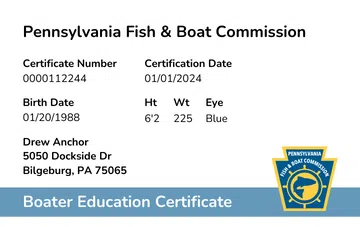
Pennsylvania does not issue a traditional boating license. Instead, the state requires a Boating Safety Education Certificate (BSEC) administered by the Pennsylvania Fish and Boat Commission (PFBC). This certificate proves you have completed an approved boating safety course and passed the final exam.
The certificate is valid for life. It never expires and does not need to be renewed. Once you earn it, you carry it whenever you operate a vessel that requires it. Pennsylvania recognizes NASBLA-approved certificates from other states, and most other states recognize Pennsylvania’s certificate in return.
Throughout this guide, we use the terms “boating license,” “boating certificate,” and “boater education card” interchangeably since they all refer to the same document: the Pennsylvania Boating Safety Education Certificate.
Two groups of boaters are required to hold the BSEC in Pennsylvania:
If you were born before January 1, 1982, and you only operate motorboats (not PWCs), you are not required to have the certificate. However, the PFBC encourages all boaters to take the course regardless of legal obligation.
The requirement applies to the person operating the vessel, not the owner. So if you own a boat but someone else drives it, the operator is the one who needs the certificate.
Note: Even though unpowered boats do not require the BSEC, kayaks, canoes, SUPs, and similar vessels still need either a boat registration or a PFBC launch permit to access PFBC lakes and state park waters.
Age determines both whether you need the certificate and whether you can legally operate a vessel at all in Pennsylvania.
Age | Motorboat (>25 HP) | PWC / Jet Ski | Motorboat (≤25 HP) |
11 and under | Cannot operate under any circumstances | Cannot operate under any circumstances | No restrictions |
12-15 | Can operate with BSEC | Can operate with BSEC; no passengers 15 or under | No restrictions |
16-17 | Can operate with BSEC | Can operate with BSEC | No restrictions |
18+ (born on/after 1/1/1982) | BSEC required | BSEC required | No BSEC required |
18+ (born before 1/1/1982) | No BSEC required | BSEC required | No BSEC required |
Children 11 and under are completely prohibited from operating motorboats above 25 HP and all personal watercraft. There is no supervision exception that overrides this rule.
Boaters aged 12 through 15 who operate a PWC face an additional restriction: they cannot carry any passengers who are also 15 years of age or younger.
For a detailed breakdown of every age scenario, see our full guide to Pennsylvania boating license age requirements.
Several categories of boaters are exempt from the BSEC requirement:
These exemptions do not apply to PWC operation. All PWC operators must hold a valid BSEC regardless of any other factor. For the full details on each exemption, see our guide to Pennsylvania boating license exemptions.
Getting your Pennsylvania Boating Safety Education Certificate involves three steps.
The PFBC approves several course providers, including online and in-person options. Online courses are the most popular choice because they let you work at your own pace from any device. The Recademics Pennsylvania Boater Safety Course is approved by the PFBC and can be completed entirely online.
In-person classroom courses are also available through various organizations and are typically held on weekends. These tend to take a full day (around 8 hours).
The course covers Pennsylvania boating laws, navigation rules, safety equipment requirements, emergency procedures, and environmental responsibilities. Online courses typically take 3 to 8 hours depending on your pace.
At the end of the course, you must pass a proctored final exam. Most courses require a score of 80% or higher. If you do not pass on your first attempt, you can retake the exam.
After passing the exam, you will immediately receive a temporary Boating Safety Education Certificate that you can print. This temporary certificate is valid for 60 days while you wait for your permanent card.
Your permanent certificate arrives by mail within 4 to 6 weeks. It is a durable plastic card that is valid for your lifetime. You must carry this certificate on board whenever you operate a vessel that requires it.
The cost of obtaining your BSEC depends on which course provider you choose. Most PFBC-approved online courses range from $35 to $60. There is no additional state fee for the certificate itself.
If you ever lose your card, the PFBC charges $5 for a replacement certificate. Processing takes 4 to 6 weeks.
For a full breakdown of costs, fees, and how to avoid hidden charges, see our guide to Pennsylvania boating license costs.
Factor | Online Course | In-Person Course |
Duration | 3-8 hours (self-paced) | ~8 hours (one day) |
Cost | $35-$60 | Free to $50 (varies) |
Flexibility | Start, stop, resume anytime | Fixed schedule |
Device | Computer, tablet, or phone | Attend in person |
Certificate | Instant temporary PDF | Issued at end of class |
Availability | 24/7, year-round | Scheduled dates only |
Online courses offer the most convenience for most boaters. You can complete the material over several days or finish in one sitting. The Recademics course is fully mobile-friendly and provides your temporary certificate immediately upon passing.
Pennsylvania participates in NASBLA’s mutual recognition program. If you hold a valid boating safety certificate from another state, Pennsylvania will generally accept it for up to 60 days while you are visiting.
After 60 days, or if you become a Pennsylvania resident, you must obtain the Pennsylvania BSEC.
Going the other direction, your Pennsylvania certificate is recognized in most other states. However, some states have additional requirements or age rules that may apply.
See our full guide to whether your Pennsylvania boating license is valid in other states.
Operating a vessel without a required BSEC is a summary offense in Pennsylvania. Waterways conservation officers can issue citations during routine stops or safety inspections.
Fines vary but typically range from $100 to $250 for a first offense. If you have the certificate but fail to carry it on board, you can still be cited, though the penalty is generally less severe.
Beyond fines, operating without proper certification can affect your liability in the event of an accident. Insurance claims may be complicated if you were not legally authorized to operate the vessel.
For the full penalty schedule and enforcement details, see our guide to penalties for boating without a license in Pennsylvania.
Boat registration is a separate requirement from the boating education certificate. All motorized vessels operated on Pennsylvania waters must be registered with the PFBC and display a valid registration number.
Registration fees depend on boat length: $22 for boats under 16 feet, $40 for 16 to under 20 feet, and $60 for 20 feet and over. Registrations are valid for two years.
Non-motorized boats (kayaks, canoes, SUPs) are not required to be registered but must display either a boat registration or a launch permit to use PFBC access areas and state park waters.
For the complete registration process, fees, and titling requirements, see our guide to Pennsylvania boat registration.
If your permanent card is lost, damaged, or stolen, you can apply for a duplicate through the PFBC. The replacement fee is $5, and you can submit the application by mail using the PFBC’s Duplicate Safety Certificate Application Form.
Processing takes approximately 4 to 6 weeks. In the meantime, contact the PFBC at (888) 723-4741 or (717) 705-7851 for guidance on obtaining a temporary verification of your certification status.
Pennsylvania requires a Boating Safety Education Certificate (not a traditional license) for anyone born on or after January 1, 1982, who operates a motorboat over 25 HP, and for all PWC operators regardless of birth date.
Online courses typically take 3 to 8 hours depending on your pace. In-person courses are usually about 8 hours in a single day. Online courses let you start and stop as needed.
Yes. Once you complete the course and pass the exam, your certificate never expires. You do not need to renew it.
Yes. Approved online courses like the Recademics Pennsylvania Boater Safety Course are fully compatible with smartphones, tablets, and computers.
No. Kayaks, canoes, SUPs, and other unpowered boats do not require the Boating Safety Education Certificate. However, you do need a launch permit or boat registration to access PFBC lakes and state park waters. See our full guide to whether you need a boating license for a kayak in Pennsylvania.
If you are renting a motorboat over 25 HP and you were born on or after January 1, 1982, yes. If you are renting a PWC, yes, regardless of birth date. See our complete guide to boating license requirements for rental boats in Pennsylvania.
Commonwealth of Pennsylvania. (n.d.). Apply for a boating safety education certificate and course. PA.gov. Retrieved June 8, 2026, from https://www.pa.gov/services/fishandboat/apply-for-bsec-and-safety-courses
Pennsylvania Fish and Boat Commission. (n.d.). Boating FAQs. Commonwealth of Pennsylvania. Retrieved June 8, 2026, from https://www.pa.gov/agencies/fishandboat/faqs/boating-faqs
Pennsylvania Fish and Boat Commission. (n.d.). Boating regulations. Commonwealth of Pennsylvania. Retrieved June 8, 2026, from https://www.pa.gov/agencies/fishandboat/boating/regulations
58 Pa. Code § 91.6 — Boating Safety Education Certificates. (2026). Pennsylvania Code & Bulletin. Retrieved June 8, 2026, from https://www.pacodeandbulletin.gov/Display/pacode?file=/secure/pacode/data/058/chapter91/s91.6.html

This is a FREE Boating course.