

Don’t let a missing certification ruin your weekend at Ocean City. We’ve simplified the Maryland boating license into a straightforward guide, covering exactly who needs a license, how to get one, and the ‘insider’ tips our students use to pass the exam on their first try.
Getting a Maryland boating license is simple and can be completed in three steps:
Take a Maryland DNR–Approved Boater Education Course
Choose a boater education course approved by the Maryland State Police & Department of Natural Resources (like Recademics), offered online or in person by authorized providers.
Complete the Course and Pass the Exam
Finish the course, review Maryland boating laws, safety requirements, and navigation rules, then pass the final exam.
Receive Your Maryland Boater Education Certificate
After passing, you’ll receive your Maryland Boater Education Certificate, which must be carried while operating a motorized vessel or personal watercraft.
If you spend any time around Maryland marinas, boat ramps, or rental counters, you’ll hear people use the term boating license almost exclusively. What most people call a “boating license” is actually a Maryland Boater Safety Education Certificate issued after you complete a state-approved safety course.
For clarity: the official credential is the Boater Safety Education Certificate, which is issued under the authority of the Maryland State Police.
Because the vast majority of Maryland boaters refer to it as a boating license, we’ll use that term throughout this article to match how people actually talk about the requirement. Just keep in mind that in Maryland, “boating license” and “Boater Safety Education Certificate” refer to the same credential.
Maryland State Police–Approved Online Boater Safety Course — Take a boater safety course approved by the Maryland State Police to get certified and legally operate a boat or personal watercraft in Maryland.
Do you need a boating license in Maryland? — Clear explanation of who needs a Maryland boating license based on age, vessel type, engine horsepower, and personal watercraft (PWC) laws.
Do I Need a Boating License to Rent a Boat? — Find out when renters must show proof of boater safety education to operate rental boats and jet skis at marinas and waterfront facilities in Maryland.
Maryland Boating Age Requirements — Detailed breakdown of minimum age rules for operating boats, PWCs, and other motorized vessels in Maryland, including supervision requirements.
Jet Ski License Rules — Maryland jet ski (PWC) license requirements explained, including age limits, engine power rules, and mandatory boater safety education.
Select a boater education course that is approved by Maryland through the Maryland Department of Natural Resources (MD DNR). Choosing a state-approved course ensures the training is legitimate and legally accepted.
Approved course websites should clearly state that they are Maryland DNR–approved and meet NASBLA (National Association of State Boating Law Administrators) standards. You can also verify approved providers directly on the Maryland DNR Boater Safety Education page.
Complete all required lessons and pass the final exam. Maryland-approved courses cover boating safety material that complies with NASBLA national standards and includes Maryland-specific boating laws, regulations, and safety requirements.
After completing the course, you must pass a final exam. The exam is based on both national boating safety content and Maryland-specific rules. A passing score is required to successfully complete the course. Most online courses allow multiple attempts.
Once you pass the exam, you’ll receive proof of certification. In Maryland, this typically includes:
A temporary certificate you can print or store digitally and use immediately
A permanent Maryland Boater Safety Education Certificate, which is valid for life and does not expire
Under Maryland law, anyone born on or after July 1, 1972 must carry a Boater Safety Education Certificate in order to operate a motorized vessel. In practical terms, if you plan to drive a boat or jet ski on Maryland waters such as the Chesapeake Bay, the Potomac River, or inland lakes like Deep Creek Lake, you will need to complete a state approved boating safety course first.
Even if you were born before the requirement took effect and are not legally required to carry a certificate, the Maryland Department of Natural Resources strongly encourages all boaters to complete boating safety training. Many experienced Maryland boaters choose to take a course anyway, especially if they plan to operate on larger and busier waters like the Chesapeake Bay where navigation rules, tides, and boating traffic can be more complex.
If your situation is more specific, such as renting a boat or operating a jet ski, the rules can be slightly different. The guides below explain those situations in detail so you know exactly what is required before heading out on the water.
From talking with Maryland boaters over the years, one thing is clear. The boating license rules are not always easy to interpret, especially when it comes to birthdate requirements, rentals, and jet skis. That is exactly why we built our “Do You Need a Boating License?” tool to quickly show whether you need a certificate.
The Maryland Department of Natural Resources urges all boaters to complete a boating safety course, regardless of requirement. However, a boating education course is only required for certain individuals. The laws dictating these specific rules are detailed below:
For More Information:
Read: Age Requirements for Operating a Boat in Maryland
In Maryland, boater safety courses must be NASBLA-approved and recognized by both the Maryland Department of Natural Resources (DNR) and the Maryland State Police, which jointly oversee and enforce boating safety and education requirements in the state.
These approved courses are available online and in person, allowing boaters to choose the format that best fits their schedule. Most courses take approximately 3–8 hours to complete, depending on the provider and delivery method. Online courses are self-paced and convenient, while in-person classes offer direct instruction and interaction.
After successfully completing an approved course, you’ll receive a Maryland Boater Safety Education Certificate, which serves as proof that you’ve met both state enforcement requirements and national boating safety standards established by National Association of State Boating Law Administrators (NASBLA).
Maryland-approved courses are offered through recognized providers such as Boat Ed, the U.S. Coast Guard Auxiliary, and programs listed through the Maryland DNR.
Recademics offers a Maryland Department of Natural Resources (MD DNR)–approved online boater safety course that satisfies all state boater education requirements. The course meets NASBLA national standards and includes Maryland-specific boating laws, regulations, and safety rules required to legally operate a vessel in Maryland.
Web-based boating safety courses are available through several state-approved providers. Online course options charge a one-time fee, generally ranging from $20 to $40.
The state offers live, in-person and instructor-led courses for free. These courses are volunteer lead and scheduled throughout the year.
Alternative in-person courses include options provided by the:
Depending on your age, you must have a boater education certificate in order to operate a boat on Maryland waterways. Certified boaters keep Maryland waterways safe. When you complete the requirements for earning a boating license in Maryland, you also demonstrate you’ve mastered the knowledge and operational skills to ensure that you safely operate a vessel safely.
Maryland averages around 100 to 130 reportable boating accidents each year. In 2023, there were 116 boating accidents reported on Maryland waterways, continuing a gradual decline from previous years.
Boater education is one of the smartest decisions you can make before heading out on Maryland’s lakes, rivers, and coastal waters. Studies consistently show that boaters who complete an approved safety course are significantly less likely to be involved in accidents and are better prepared to handle on-the-water emergencies.
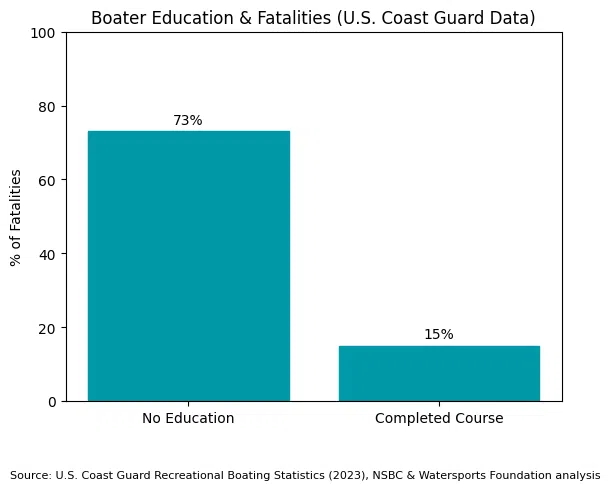
Boater education is essential for enhancing safety on Maryland’s waterways, significantly reducing accidents and fatalities. Maryland’s boating safety courses provide vital knowledge on navigation rules, emergency procedures, and the proper use of safety equipment. Educated boaters contribute to a safer and more enjoyable experience for everyone on Maryland’s diverse waters.
No, you do not need to renew the Maryland boating license. It is good for life!
Yes! The Maryland Boating License is recognized in all 50 states and Canada. This is known as reciprocity.
If you lose your boating license or it is stolen, contact the course provider who issued your license. As a fallback, you can contact the Maryland Department of Natural Resources to obtain a new one. There may be replacement and processing fees.
In Maryland, there is no minimum age requirement to take a boating safety course and obtain a boating safety education certificate. However, to legally operate a motorized vessel, individuals born on or after July 1, 1972, must have this certificate. It’s important to note that specific age-related restrictions apply to the operation of certain types of boats and personal watercraft (PWC). For example, operators of PWC must be at least 16 years old.
The Maryland boating license is good for life and does not need to be renewed. However, it’s a good idea to take a refresher course once in a while because laws change!
The cost to obtain a boating license online in Maryland ranges from $35 to $60.
If you are caught boating without a required boating safety education certificate in Maryland, you could face several consequences. The Maryland Natural Resources Police may issue you a citation, which could result in fines and penalties. Additionally, operating a boat without the proper certification can lead to increased scrutiny and inspections of your vessel. Repeat offenses or serious violations may result in more severe penalties, including potential court appearances.
Maryland Department of Natural Resources. “Boating Safety Education & Certificate Requirements.” Accessed June 4, 2024. https://dnr.maryland.gov/boating/Pages/safety.aspx.
Maryland Department of Natural Resources. “Personal Watercraft Operation Requirements.” Accessed June 4, 2024. https://dnr.maryland.gov/boating/Pages/pwc.aspx.
Maryland Department of Natural Resources. “Boating Regulations.” Accessed June 4, 2024. https://dnr.maryland.gov/boating/Pages/regulations.aspx.
Recademics is a nationally recognized provider of outdoor recreation safety education, offering online certification courses for boating, hunter education, bowhunter education, off-highway vehicles (OHV/off-road), snowmobiles, and personal watercraft (PWC). Our courses are built around nationally established standards and regulatory frameworks, with alignment to NASBLA (boater education) and IHEA-USA (hunter and bowhunter education).
We currently have more than 32 state-approved courses issued directly by state agencies across the United States, including approvals in Texas, New York, Florida, California, Georgia, Alabama plus many more & with additional states pending. Every course is developed and maintained by subject-matter specialists, instructional designers, and state-reviewing authorities to ensure accuracy, compliance, and a high-quality learning experience.
Recademics focuses on clear instruction, accuracy, and straightforward pathways to certification for outdoor enthusiasts across multiple disciplines. Our goal is simple: make it easier to get certified, stay compliant, and enjoy the outdoors with confidence.
This is a FREE Boating course.