The following boats are required to be registered:
All motorized boats, regardless of length. This includes boats powered by gasoline, diesel, or electric motors and sailboats with an auxiliary engine.
All non-motorized vessels that are 14 feet or longer.
Federally documented vessels operating in Texas
Registration establishes the identification and responsibility for a watercraft.
Not all boats are required to be registered in Texas. Exempted watercraft include rubber rafts, paddle craft, and other vessels that are human powered such as:
Sailboats under 14 feet in length without an auxiliary engine are not required to be registered.
Boats that are not powered by an internal combustion outboard motor are exempt from the registration requirement.
All canoes, kayaks, punts, rowboats, rubber rafts, or other vessels under 14 feet in length when paddled, poled, oared, or windblown.
While these vessels do not need registration, they are still required to carry one Coast Guard approved PFD for each person on board, and required to display navigation lights according to the federal guidelines for each vessel type.
The registration process for boats in Texas involves several key steps:
Complete the Required Application Forms: You must fill out the appropriate application forms for registering your vessel. You can find these forms at https://tpwd.texas.gov/faq/fishboat/boat/registration_and_titles/#faq5
Submit Additional Documentation: Along with your completed application forms, you will need to submit any additional required documentation. This may include proof of ownership, such as a bill of sale or a manufacturer’s statement of origin for new vessels.
Pay the Required Fees: Determine the applicable registration fees for your vessel and ensure that these fees are paid as part of your application process.
Inspection for Homemade Vessels: If your vessel is homemade, you must submit an affidavit regarding the origin of the vessel and receipts for materials used in its construction. Additionally, your vessel will need to be inspected and certified by a Texas game warden.
Registration for Documented Vessels: If your vessel is a larger recreational vessel owned by U.S. citizens and documented by the U.S. Coast Guard, it must also be registered with the Texas Parks and Wildlife Department (TPWD).
Submit Your Application: You can submit your completed application forms, documentation, and fees either through the mail or in person at a TPWD office or an authorized marine dealership.
Once registration is complete, the certificate of registration or a copy of it must be on board and available for inspection by an officer whenever the vessel is being operated.
The display of registration numbers on boats in Texas must adhere to state law. Placement and Visibility:
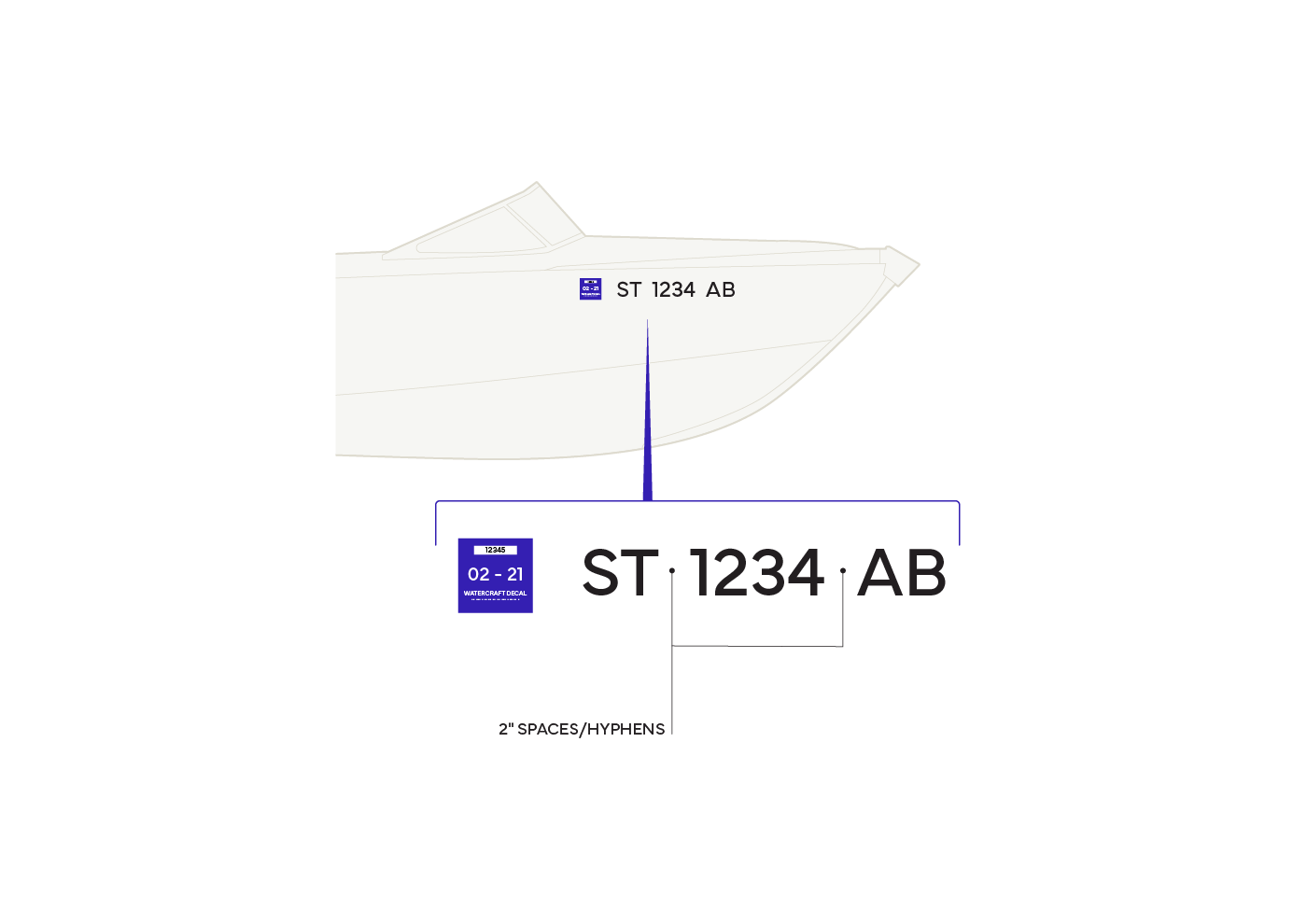
The registration number must be painted on, attached as a sticker or decal, or otherwise affixed to the forward half of the vessel.
It must be displayed on both sides of the bow (the front part of the boat).
Appearance:
The registration number must be in at least 3-inch-high BLOCK letters.
The color of the numbers must contrast with the background to ensure they are easily readable.
Letters must be separated from the numbers by a space or hyphen, for example, TX 0001 GG or TX-0001-GG.
Exclusivity:
No other numbers may be displayed on the bow. This rule helps to avoid confusion and ensures that the registration number is clearly identifiable.
Registration decals, also known as validation stickers, indicate that a vessel is legally registered to operate on public waters. The decals must be placed on each side of the vessel, 3 inches behind (toward the stern) and in line with the registration number.
Boaters are required to renew their vessels’ registration every two years. The expiration date for your certificate of number is listed directly on the certificate and on the validation decals.
Renewal Notice:
The Texas Parks and Wildlife Department (TPWD) will send a renewal notice to the vessel owner about three months before the expiration date via mail or electronic communication.
Renewal Process:
The completed application for renewal may be returned to the department, to any county tax assessor-collector, or, if permitted by the department, to an agent of the department.
A completed application not received during the 90-day period before the expiration date shall be treated in the same manner as an original application.
The department, an authorized agent, or a county tax assessor-collector may not issue a renewal certificate of number unless the tax due on the vessel is paid.
Address Change or Vessel Status:
If you have changed addresses, you must notify TPWD within 15 days of the change to ensure you receive your renewal notice.
If you abandon or destroy your vessel, you must report it to TPWD within 20 days and surrender your Certificate of Number and title if applicable.
Vessel owners are required to renew their validation decal on an annual basis.
Validity Period: A registration decal is valid only during the yearly period for which the decal is issued, without regard to the date on which the decal is acquired.
Yearly Period: This period begins on September 1 or another date set by the commission and extends through August 31 of the next year or another date set by the commission.
Renewal of Validation Decals
Renewal Notice: TPWD mails the renewal notice to the owner of the vessel, or sends it electronically if the owner has agreed to receive department communications electronically, during the last 90 days before the expiration date of the certificate.
Renewal Process:
The completed application for renewal can be returned to the department, to any county tax assessor-collector, or, if permitted by the department, to an agent of the department.
A completed application not received during the 90-day period before the expiration date shall be treated in the same manner as an original application.
The department, an authorized agent, or a county tax assessor-collector may not issue a renewal certificate of number unless the tax due on the vessel under Chapter 160, Tax Code, is paid.
Duplicate Decals: If a registration decal becomes lost, mutilated, or illegible, the owner of the vessel for which the decal was issued may obtain a replacement decal on application to the department and the payment of a fee of $2 or an amount set by the commission, whichever amount is more.
This comprehensive approach ensures that all vessels operating on public waters have valid registration and are in compliance with the regulations set forth by the Texas Parks and Wildlife Department.
In Texas, federally documented vessels, which are larger recreational vessels owned by U.S. citizens, may be documented by the U.S. Coast Guard (USCG). Owners of such vessels have the option to document them with the USCG, which provides evidence of nationality for international travel and allows for certain protections under federal law. However, it’s important to note that even if a vessel is federally documented, it must also be registered with the Texas Parks and Wildlife Department (TPWD).
To obtain more information about the process of documenting a vessel with the USCG, vessel owners can call the USCG at 1-800-799-8362. This dual requirement ensures that the vessel is recognized both federally for international purposes and locally for operations within Texas waters.
Boaters with current, valid out-of-state registration may boat on Texas waters for up to 90 consecutive days. After this period, the vessel owner must register the watercraft in Texas to continue operating.