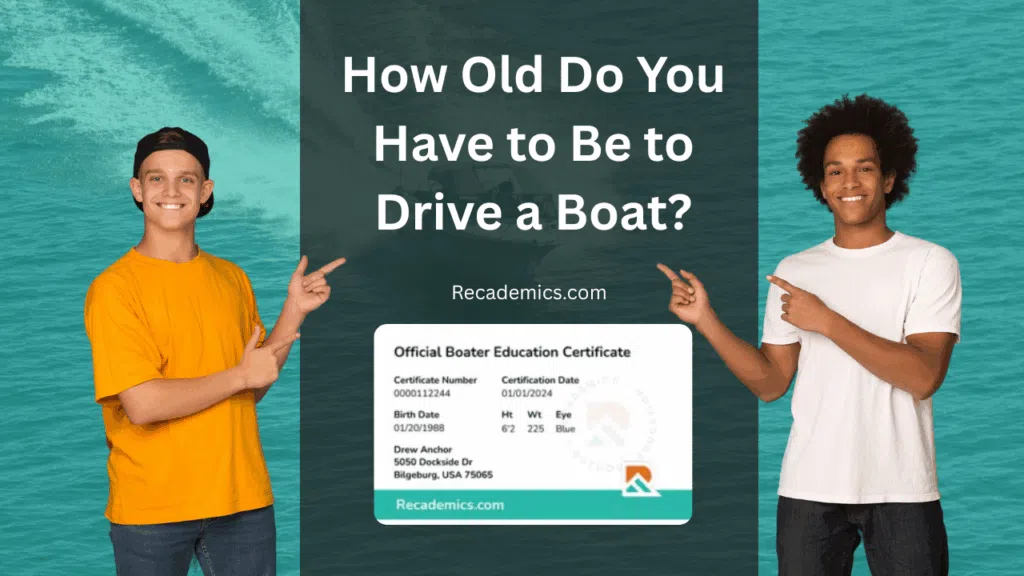
Minimum Age to Operate a Boat in Maine
General Boating Age Requirements
Maine’s boating age requirements for motorboats are based mainly on engine horsepower and boater education:
- Under 12 years old:
- May operate a motorboat alone only if the engine is less than 10 horsepower.
- If the motor is between 10 and 25 horsepower, they may operate only if they are supervised (see supervision section below).
- Under 12s are not allowed to operate higher-horsepower motorboats on their own.
- Operators 12 and older, born on or after January 1, 1999:
- Must complete a boater safety and education course to operate a motorboat for recreational purposes if the engine is more than 25 horsepower.
- They must carry their boater safety and education course certificate while operating.
- Operators born before January 1, 1999:
- Are not required by state law to complete a boating course to operate a motorboat, regardless of horsepower.
- Boating education is still strongly recommended for safety and may be required by some rental companies or insurance policies.
These rules apply to recreational boating on Maine’s inland and territorial waters and do not cover commercial passenger-for-hire operations.
Supervision and Adult-Onboard Requirements
For younger boaters, Maine law requires supervision in certain situations:
- Under 12 operating 10–25 hp: A child under 12 may operate a motorboat with a motor between 10 and 25 horsepower only under supervision. In practice, that means:
- A supervising person must be on board, in a position to take immediate control of the boat.
- If that supervisor was born on or after January 1, 1999 and the motor is greater than 10 horsepower, they must be at least 16 years old and have completed a boater safety and education course.
- Under 12 with engines under 10 hp: A child under 12 may operate alone if the motor is less than 10 horsepower, with no specific supervision requirement.
The law effectively defines a supervising “adult” (when born after January 1, 1999) as someone who is at least 16 years old, on board, and properly boater-educated when supervising a young operator using a motor greater than 10 horsepower.
Boating License or Education Requirements
Does Maine Require a Boating Safety Course?
Maine does not issue a separate “boating license.” Instead, the state uses a Boating Safety and Education Course and a Boating Safety Education Card as proof of completion. The key rule is:
- Beginning January 1, 2024, anyone born on or after January 1, 1999 must:
- Be at least 12 years old, and
- Have completed an approved boater safety and education course, and
- Carry a valid course certificate
to operate a motorboat for recreational purposes with an engine capable of producing more than 25 horsepower on Maine’s inland and territorial waters.
Boaters can find links to approved in-person and online courses on the Maine Department of Inland Fisheries and Wildlife (MDIFW) website.
Age Exceptions and Grandfather Clauses
Maine law also includes several important exceptions:
- Born before January 1, 1999: These operators are “grandfathered” and are not required to complete a boater safety course for recreational motorboat operation, regardless of horsepower. Education is still strongly encouraged.
- Maine Guides and certain professional mariners: Operators holding valid Maine guide licenses with passenger-for-hire credentials or certain U.S. Coast Guard licenses may be exempt from the course requirement when those credentials are in effect.
- Boat rentals: Renters may be allowed to operate a motorboat after completing a temporary boater safety course offered by the rental agent, instead of a full education course, for a limited time (typically up to 14 days or for the rental duration).
- Visiting boaters: Certain visiting non-U.S. boaters operating for a short period (for example, arriving by sea and operating for 60 days or less) may not be required to complete the Maine course.
How Old Do You Have to Be to Drive a Jet Ski (PWC) in Maine?
Minimum Age to Operate a PWC
Maine has specific rules for personal watercraft (PWCs), including jet skis and similar vessels:
- Under 16 years old: No one under 16 may operate a PWC on Maine waters.
- Are at least 16 years old, and
- Have completed a boater safety and education course.Born on or after January 1, 1999: Beginning January 1, 2024, a person born on or after this date may not operate a PWC unless they:
- Born before January 1, 1999: These operators are not required by statute to complete a boating safety course specifically to operate a PWC, but a course is still strongly recommended and may be required by rental businesses or insurers.
In addition, everyone operating or riding on a PWC must wear a properly fitted, U.S. Coast Guard–approved personal flotation device, and PWCs may not be operated between sunset and sunrise.
Penalties for Violating Age Laws
Maine treats underage and unqualified operation of boats and PWCs as civil violations. Typical consequences may include:
- Civil fines: For underage PWC operation or violating boater education requirements, fines are generally in the range of $100 to $500 for each violation, with higher penalties for repeat offenses.
- Escalating penalties: A person who has multiple boating violations within a five-year period may face upgraded penalties, including a Class E crime in some circumstances.
Other violations—such as reckless operation or boating under the influence—carry additional, more serious penalties beyond those tied strictly to age and education rules.
How to Get Certified to Drive a Boat in Maine
Steps to Getting Your Boating License
If you were born on or after January 1, 1999 and plan to operate a motorboat over 25 horsepower or a PWC, you’ll need to complete a state-approved boating safety course. Here’s the typical process:
- 1. Enroll in an approved boating safety course.
Choose either an online or in-person course that is approved by the Maine Department of Inland Fisheries and Wildlife and meets NASBLA standards. The MDIFW website lists current providers and options. - 2. Complete all lessons and study materials.
You’ll cover topics like boat handling, required equipment, Maine-specific boating laws, navigation rules, emergency procedures, PWC rules, and environmental stewardship. - 3. Pass the final exam.
At the end of the course, you’ll need to pass a multiple-choice exam showing you understand key safety concepts and Maine regulations. - 4. Receive your Boating Safety Education Card.
Once you pass, you’ll receive a Boating Safety and Education Course certificate or card that serves as your long-term proof of completion. - 5. Carry proof while operating.
If you’re required to be boater-educated under Maine law, you must have your certificate or card with you whenever you operate a qualifying motorboat or PWC.
Some boaters also choose to add a boating endorsement to their driver’s license where available, but you must still complete the approved safety course first.
Boating Safety Tips for Young Operators
- Always wear a life jacket.
Make sure everyone on board, especially children and PWC riders, wears a properly fitted, U.S. Coast Guard–approved life jacket every time you’re on the water. - Don’t operate without supervision if you’re required to have it.
If you’re under 12 and using a higher-horsepower motor, or you’re still learning to handle a boat, keep a responsible, experienced adult on board at all times. - Learn navigation rules early.
Study right-of-way rules, channel markers, no-wake zones, and local restrictions so you know how to avoid collisions and conflicts with other boaters. - Take your boating safety course as soon as you qualify.
Completing an approved course at 12, 16, or as soon as you’re eligible helps you boat legally and confidently throughout Maine. - Stay sober and alert.
Operating any boat or PWC under the influence of alcohol or drugs is dangerous and illegal. Save alcohol for after you’re back on shore and done boating for the day. - Check conditions before you go.
Review weather, water levels, and any lake-specific rules or PWC restrictions on the waters you plan to visit.
Summary
In Maine, how old you have to be to drive a boat depends on your age, date of birth, and the type and horsepower of the vessel. Children under 12 may operate only small motors on their own, and those born on or after January 1, 1999 must complete a boater safety and education course to operate a motorboat over 25 horsepower or to operate a PWC once they turn 16. No one under 16 may operate a jet ski or other personal watercraft at all.
By understanding Maine’s boating age and education rules, taking a state-approved safety course, and following core safety practices, young boaters can enjoy Maine’s lakes, rivers, and coastal waters legally and safely. Recademics provides education-focused resources that can help you prepare for your official Maine boating safety course and become a more confident, responsible boat operator.