
Take an Official State-Approved Boater Safety Course
Quick Answer:
Yes—West Virginia requires many operators to complete boater education before they can legally operate a motorboat or personal watercraft (PWC) on West Virginia waters. Specifically, anyone born on or after December 31, 1986 must have a boating safety education certificate (often called a boater education card) before operating a motorboat or PWC.
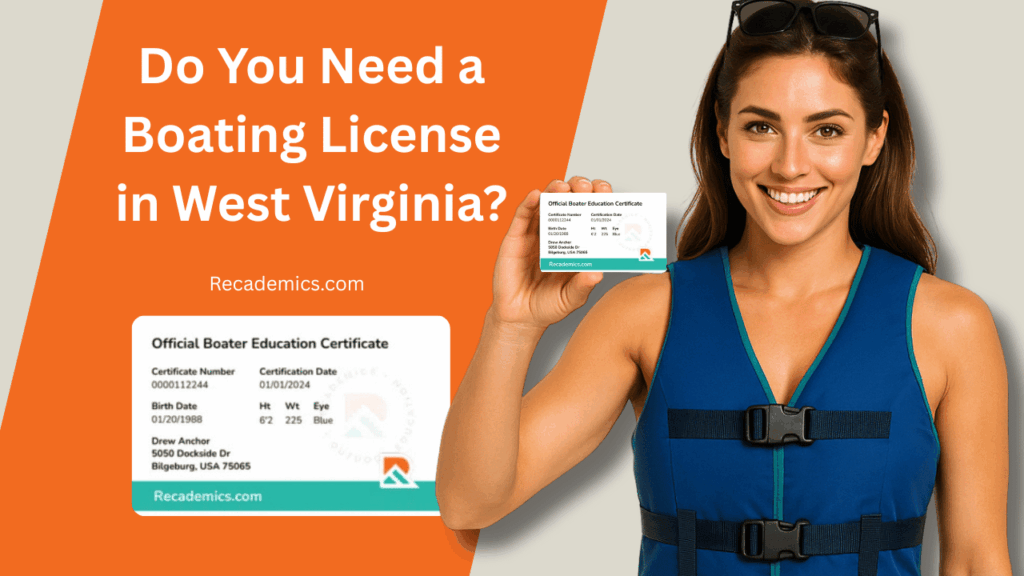
In West Virginia, you must have a boating safety education certificate if:
The required certificate can be issued by West Virginia or by another state, as long as it was earned through an accepted boating safety education program.
West Virginia has age-based operating restrictions in addition to boater education requirements. In general:
Even when an age-based exception applies, the boater education requirement can still apply depending on the operator’s date of birth and the vessel type.
West Virginia’s boater education requirement applies to operators of:
If the vessel is motorized and you fall within the required birthdate group, you should assume you need the boating safety education certificate unless an exemption applies.
Common exemptions in West Virginia include:
West Virginia accepts boating safety education certificates earned through approved instruction, including courses administered by organizations such as:
The key is that the course must be accepted under West Virginia’s requirements so your completion certificate counts as a valid boating safety education certificate.
West Virginia allows multiple ways to complete boater education:
Both options can be valid as long as the course is accepted under West Virginia’s boater education requirements.
Course length depends on the format and provider:
Always check the estimated completion time shown by the specific approved course you choose.
Yes—West Virginia recognizes boating safety education certificates earned in other states, as long as the certificate was obtained through an accepted boating safety education program.
For certain nonresident visitors, West Virginia law also ties exemptions to whether the boater education card from the boater’s home state meets NASBLA-recommended criteria.
If you’re visiting West Virginia and renting a boat, the rental process may help you meet local requirements for that rental period. West Virginia rules for boat liveries and rental facilities require them to provide a boating safety orientation to renters who do not already hold the required boating safety education certificate.
After successful orientation, the rental facility issues a temporary certificate that is valid for the rental period.
West Virginia includes time-based visitor exemptions that may apply depending on your situation:
If you stay longer than the allowed visitor period or become a frequent operator in West Virginia, you should plan to meet the standard West Virginia boater education requirements.
If you are required to have a boating safety education certificate in West Virginia and you operate without it, you may face enforcement action. Under West Virginia law, boating violations that don’t have a separate punishment listed can be treated as misdemeanors, with penalties that can include fines and possible jail time.
West Virginia also requires boaters who are subject to the education requirement to possess the certificate while operating and present it when requested by an authorized law enforcement officer.
Additionally, West Virginia’s boater education requirement is enforced as a secondary action—meaning officers generally enforce it after detaining an operator for probable cause of another violation.
West Virginia law and rules place responsibilities on owners and rental providers, including:
These responsibilities are important because a rental company that fails to follow required procedures can create safety risks and legal exposure for both the business and the operator.
Boating regulations in West Virginia may be enforced by West Virginia Natural Resources Police officers and other law enforcement officers authorized to enforce state boating laws.
In West Virginia, the “boating license” people refer to is typically not a driver-style license. The required credential is a boating safety education certificate (also called a boater education card) that shows you successfully completed an approved boating safety education course.
If you have a qualifying boating safety education card from another state, it can count in West Virginia as long as it meets West Virginia’s requirements.
If you are in the group required to have boater education (born on or after December 31, 1986) and you will be operating a motorboat or PWC, you should expect to need proof of boater education.
If you do not already have the required boating safety education certificate, West Virginia rules require boat rental facilities (boat liveries) to provide a boating safety orientation and issue a temporary certificate that is valid for the rental period after you successfully complete the orientation.
Yes. In West Virginia, personal watercraft (PWCs) are covered by boater education requirements when you are in the required birthdate group, and PWCs also have additional operating restrictions, including minimum age rules and required life jacket wear for everyone on board or being towed.
Often, yes. West Virginia recognizes boating safety education certificates from other states if they were earned through an accepted program. If you are a nonresident visiting for a limited time, your exemption may depend on factors like your age, how long you are staying, and whether your home-state certificate meets NASBLA-recommended criteria.

This is a FREE Boating course.