
Take an Official State-Approved Boater Safety Course
Quick Answer: Yes—Rhode Island requires a boating safety education certificate in two common situations: if you were born on or after January 1, 1986 and will operate a motorized vessel with more than 10 horsepower, and if you will operate a personal watercraft (PWC/jet ski) at any age. Rhode Island treats this “boating license” as a boater safety education certificate/card rather than a separate operator’s license.
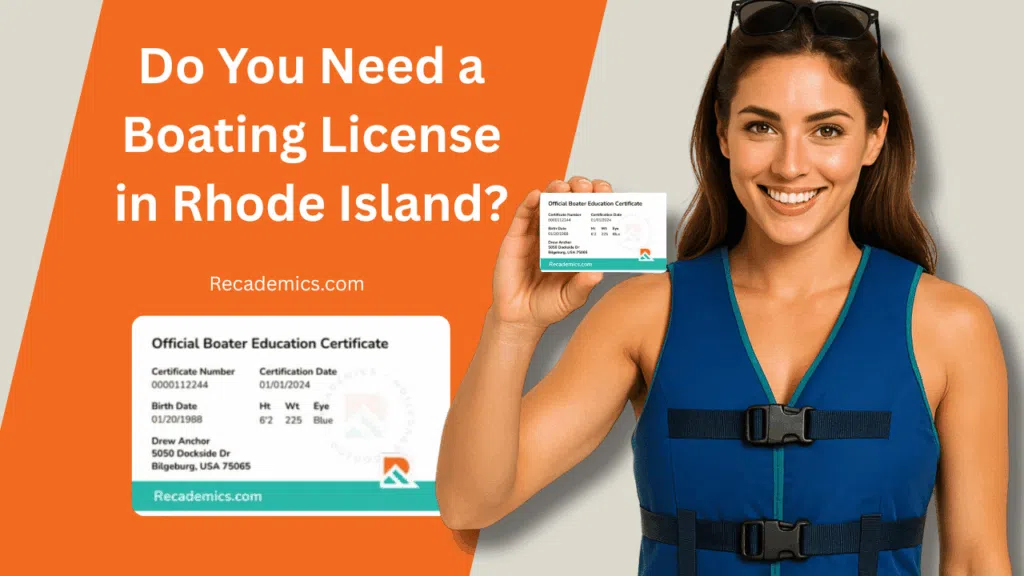
Rhode Island requires proof of approved boating safety education for:
If you are required to have the certificate, you should be prepared to present it when requested by law enforcement.
Rhode Island does not set a standalone minimum operator age in the same way some states do. Instead, the key legal threshold is whether you must have boating safety education based on:
For boaters who have not met the education requirement, Rhode Island law includes a “training/supervision” pathway for certain situations (see exemptions below).
In Rhode Island, the education requirement applies to:
Non-motorized craft (like canoes, kayaks, paddleboards, and sailboats without an engine) generally are not the focus of “boating license” rules, but they still must follow navigation and safety laws.
Rhode Island recognizes several exemptions for the motorboat (over 10 hp) education requirement tied to the 1/1/1986 birthdate rule. Common exemptions include:
Important: For PWCs, Rhode Island law requires approved boating safety education for anyone operating a PWC. In other words, exemptions that may apply to some motorboat situations generally do not remove the PWC education requirement.
Rhode Island’s required “boating license” is typically satisfied by completing a boating safety education program that meets national boating education standards (NASBLA standards) and is approved for Rhode Island compliance. Approved options commonly include courses offered through state-recognized providers such as boating safety organizations and other approved programs.
While specific provider steps vary, the standard pathway looks like this:
Rhode Island allows different ways to complete boating safety education depending on the provider, but a critical point is that Rhode Island’s process involves a supervised/proctored exam component for certification. Many boaters choose:
Course length depends on the provider and course format. Because Rhode Island requires approved instruction and a supervised exam component, many boaters should plan for:
If you’re on a tight timeline (vacation, rental reservation, weekend trip), confirm scheduling and testing availability before you arrive.
Often, yes. Rhode Island generally treats boaters as compliant if they can show proof of completing a boating safety course that meets national boating education standards (NASBLA). Additionally, Rhode Island law recognizes that visiting non-residents who meet the boating education requirements of their home state may be considered compliant while temporarily using Rhode Island waters.
However, always verify that your card/certificate is from a recognized, standards-based program and keep proof with you while operating.
Rhode Island’s boating safety education law focuses on whether you already meet the education requirement (through Rhode Island or your home state) rather than issuing a separate short-term “visitor license.” If you’re visiting:
For rentals, Rhode Island may allow certain renters to meet safety requirements through livery-provided education steps, depending on the type of craft being rented.
If you operate when boating safety education is required and you don’t have proof of compliance, you may be stopped and sanctioned. Rhode Island’s boating safety education law includes escalating consequences, such as:
Separately, dangerous operation, boating under the influence, reckless operation, or accidents can trigger much more serious penalties under other boating laws.
Rhode Island places specific responsibilities on boat liveries (rental businesses) for certain rentals of boats over 10 horsepower when renters do not already meet the education requirement. This can include requiring renters to complete safety steps such as watching an instructional video and passing an exam before operation.
For operators, the bottom line is simple: if you will operate the craft yourself, make sure you meet Rhode Island’s education requirement before leaving the dock.
Boating rules in Rhode Island may be enforced by authorized law enforcement officers, including Rhode Island’s environmental and boating enforcement authorities and local officials in certain waterways. You should be prepared to present required certificates and documents upon request.
In Rhode Island, the “boating license” people refer to is typically the Certificate of Boating Safety Education (also called a boater education card/certificate). It is proof that you completed an approved boating safety education program and passed the required exam. For boaters who must be certified, it should be carried and available when operating.
If you will operate the rental yourself, you generally need boating safety education when:
Some rental operations may offer a required safety video/exam process for certain rentals when the renter does not already meet the standard education requirement, but you should confirm this with the rental company well before your reservation.
PWCs (jet skis) are covered by strict education rules in Rhode Island. Rhode Island requires approved boating safety education for anyone operating a PWC, regardless of age.
Often yes—especially if your card/certificate is based on national boating education standards (NASBLA) and you otherwise meet the requirements of your home state while visiting. To avoid problems:

This is a FREE Boating course.