
Take an Official State-Approved Boater Safety Course
Quick answer: Nevada does not issue a traditional “boating license” for recreational boaters, but you may be required to carry a Boater Education Card / proof of boater safety education. If you were born on or after January 1, 1983 and you operate a motorboat with an engine over 15 horsepower on Nevada’s interstate waters (waters forming the boundary between Nevada and an adjoining state), you must meet Nevada’s boater education requirement or qualify under an allowed alternative (such as a U.S. Coast Guard credential, a temporary operator permit in limited cases, a qualifying rental agreement, or certain visitor rules).
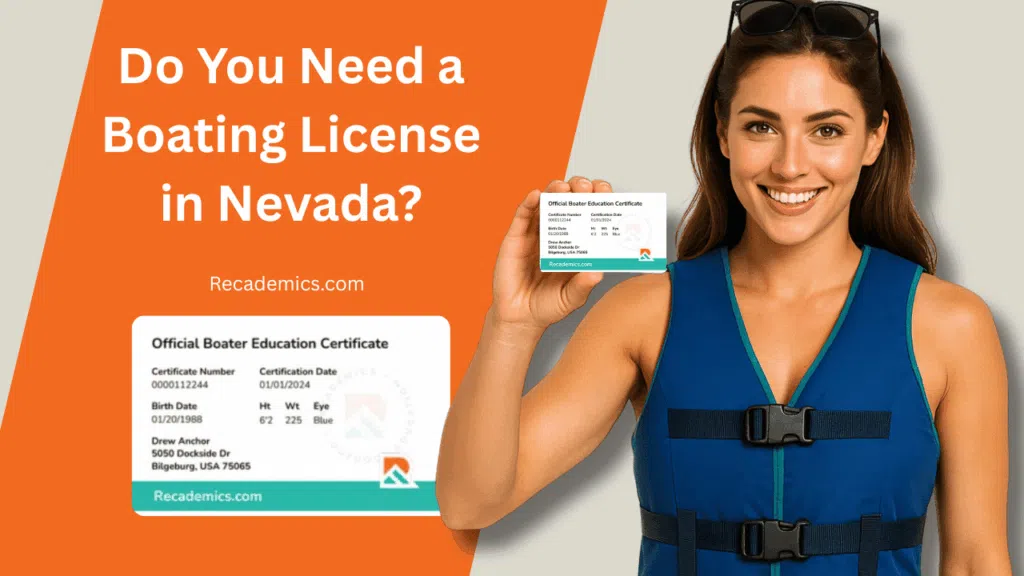
You are required to meet Nevada’s boater education requirement if you:
To comply, you generally need to have completed an approved boater safety course (or an allowed equivalent) and be able to present the required documentation if stopped by law enforcement.
Nevada does not set a single minimum age for operating all boats. However, there are important age-based rules for certain activities and vessel types:
Nevada’s requirement is not a “license” in the driver’s-license sense. The boating education requirement is triggered by:
For PWCs (Jet Skis), Nevada law requires the operator to meet PWC-specific rules (including the minimum age) and also to satisfy any applicable boater education provisions that apply to the operator and where they’re boating.
You may be able to operate without completing a Nevada boater education course if you qualify under an allowed alternative. Common exceptions/alternatives include:
To meet Nevada’s education requirement, you can complete a boater safety course that is recognized for Nevada’s mandatory education rule (commonly a NASBLA-approved course) or pass an approved proficiency exam. Nevada’s boating education program is administered through the Nevada Department of Wildlife (NDOW), which publishes approved/recognized education options.
Nevada boaters typically have multiple ways to complete boating safety education:
Whichever method you choose, the key is that your completion must satisfy Nevada’s requirements for the waters and vessel you plan to operate.
Course length varies by provider, course format (online vs. classroom), and your pace. Plan enough time to fully review the material and pass the required assessment. If you’re boating soon, start early so you have your completion documentation ready before you go out—especially if you will be operating on interstate waters where the requirement applies.
In many cases, yes. Nevada’s law recognizes boating education that meets national standards (commonly NASBLA-approved boating education). If you already hold a boater education certificate/card from another state, it may be accepted if it meets the recognized standard.
Always verify that your certificate is from a qualifying course and keep it with you while operating.
Nevada’s rules include limited “temporary” pathways depending on your situation:
If you’re renting, your rental/lease agreement (when compliant with Nevada’s rental rules for interstate waters) can also serve as an allowable form of documentation for certain operators.
If you’re visiting Nevada to boat:
If you are required to have boating education documentation and you cannot present the acceptable proof when stopped, Nevada law allows enforcement action. Failing to present the required documentation can be treated as evidence of a violation, and it may be charged as a misdemeanor unless you later present the required documents in court showing you were compliant at the time.
Because penalties and enforcement can vary by situation, the safest approach is to carry your boater education card/certificate (or other qualifying documentation) whenever you operate where the requirement applies.
Nevada law places specific duties on businesses that rent or lease motorboats for operation on interstate waters. Depending on the circumstances, rental businesses may be required to:
Operators also have responsibility: only those listed as authorized operators should operate the rented vessel, and minors listed as operators may need adult supervision while operating.
Boating laws may be enforced by NDOW game wardens and other law enforcement officers with authority on Nevada waters, including sheriffs and other peace officers. On some waters, additional federal or local agencies may also be present depending on the location.
When people say “boating license” in Nevada, they usually mean one of these:
If you’re unsure which document applies to you, base your decision on (1) your birth year, (2) engine horsepower, and (3) whether you’ll operate on Nevada’s interstate waters.
Possibly. Nevada has special rules for renting/leasing motorboats intended for operation on interstate waters. Depending on your birth year, age, and where you plan to operate, the rental company may require you to sign an affidavit, may require you to be 18 or older to rent certain vessels, and may list authorized operators on the rental agreement. If you’re required to meet boating education rules, be prepared to show your boater education certificate/card or other qualifying documentation—or ensure you’re properly listed on a compliant rental agreement.
PWCs (Jet Skis) have additional requirements in Nevada. At a minimum, the operator must be at least 14 years old, and PWC operation is also tied to applicable boater education provisions (especially when the operator and boating location trigger Nevada’s education requirement). PWCs also come with added safety requirements such as life jacket rules for riders and other operational restrictions.
Often, yes—especially if your out-of-state card is from a course that meets recognized national boating education standards. If you’re a visitor, Nevada’s rules may also look to whether you are complying with your home state’s boater education requirements (if any). Carry your certificate/card with you whenever you operate.

This is a FREE Boating course.