The Ultimate Guide to Getting the Ohio Boating License
This guide explains how to get a Ohio boating license with step-by-step instructions, eligibility requirements, and approved boater education courses.
Steps to Get an Ohio Boating License
Getting boating license in Ohio is simple and can be completed in three steps:
1. Take an ODNR-Approved Boater Education Course Choose an Ohio Department of Natural Resources-approved course, offered online or in person by authorized providers.
2. Complete the Course and Pass the Exam Finish the Ohio boating course, review boating safety and navigation rules, and pass the final exam.
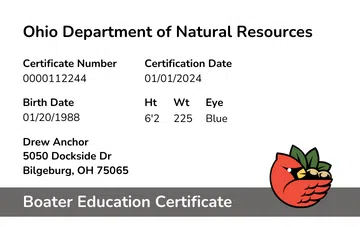
3. Receive Your Ohio Boater Education Certificate After passing, you’ll receive your Ohio Boater Education Certificate, which must be carried while operating a boat or jet ski.
The Ohio Boating License is officially named a boater education certificate.
You need a boating license if you were born on or after January 1, 1982, and will be operating a boat or personal watercraft (PWC).
To get one, take an ODNR-approved boater safety course (like Recademics). You will receive the certificate at the end of the course after passing a final exam.
You have to have the boating license on you when you operate a boat (just like a driver’s license).
The Ohio Department of Natural Resources administers the boater safety program.
What is the Ohio Boating License?
In Ohio, what most people call a “boating license” is actually an Ohio Boater Education Certificate issued after you complete a state-approved boating safety course. Ohio does not issue a traditional driver’s-license-style credential for operating a boat, so the term “boating license” isn’t technically correct but it’s the common phrase people use to describe the requirement.
For clarity: the official name is the Ohio Boater Education Certificate, but because many Ohioans refer to it as a boating license, we’ll use that term throughout this article. Just keep in mind that they refer to the same thing in this context.
Ohio Boating License & Safety Quick Navigation
ODNR-Approved Online Ohio Boater Safety Course — Take the official Ohio Department of Natural Resources–approved online boater safety course to get certified and legally operate a boat or personal watercraft in Ohio.
Do you need a boating license in Ohio? Clear explanation of who needs an Ohio boating license based on age, vessel type, horsepower limits, and personal watercraft (PWC) operation laws.
Ohio Boating Age Requirements Detailed breakdown of minimum age rules for operating boats, PWCs, and motorized vessels in Ohio, including supervision requirements.
Jet Ski License Rules Ohio jet ski (PWC) license requirements explained, including legal age limits and mandatory boater education rules.
How to get an Ohio Boating License
Check whether you need boater education to drive a boat. You can use our helpful “Do You Need a Boating License?” tool above!
Print and carry your Ohio Boater Education Certificate on board your boat.
For a detailed step-by-step guide, view the video below or keep reading!
Step-by-Step Detailed Instructions to Get a Boating License in Ohio
Choose an Approved Boating Course
Select a boater education course that Ohio approves through the Ohio Department of Natural Resources (ODNR). This is the best way to ensure the course meets state requirements. The course website should clearly state that it is ODNR-approved, display the NASBLA logo, and indicate compliance with Ohio boating laws. You can also confirm approved courses through ODNR’s official boater education resources.
Complete all required lessons and pass the final exam. Approved Ohio courses cover boating safety content that complies with National Association of Boating Law Administrators (NASBLA) standards and includes Ohio-specific laws, regulations, and safety requirements.
Once you finish the course, you must pass the final exam to demonstrate competency. The approved provider sets exam format and scoring requirements but must meet ODNR and NASBLA standards.
Receive Your License
After passing the exam, you’ll receive proof of certification. In Ohio, this typically includes:
A permanent Ohio Boater Education Certificate you can instantly download after you pass the exam.
Important: You must carry your Ohio Boater Education Certificate with you whenever you operate a boat that requires boater education under Ohio law.
Do you need a Boating License in Ohio?
Anyone born on or after January 1, 1982, who plans to operate a motorboat over 10 HP or a PWC must complete an ODNR-approved boater education course.
Use this interactive tool to discover if you need the Ohio Boating License. Answer two simple questions and press "check". You will be presented with the answer and your next step to get a boating license if you need it.
A boating license is required for operators who were born on or after January 1, 1982, and who operate a personal watercraft (jet ski) or a motorboat with more than 10 horsepower on Ohio public waters. There are several exemptions and alternative compliance options, along with different rules for supervised operation, out-of-state visitors, and rental situations.
For special exemptions, out-of-state rules, supervised operation, and other scenarios, see our in-depth articles:
Even if you aren’t legally required to hold a boating license, the Ohio Department of Natural Resources (ODNR) strongly emphasizes the importance of boating safety education and encourages all boaters to complete a formal boating safety course.
Who can operate a boat in Ohio?
In Ohio, the minimum age to operate a boat depends on both age, vessel type, and boater education.
If you have an Ohio-approved boater education certificate, you can operate a motorboat with more than 10 horsepower starting at age 12.
Personal watercraft (jet skis) are different: you must be at least 16 years old, even if you have the certificate.
Children below Ohio’s minimum age thresholds cannot operate powered vessels on their own, even with a boater education certificate.
Anyone born on or after January 1, 1982, must still meet Ohio’s boater education requirement.
There are additional rules covering supervised operation, rentals, PWCs, out-of-state certificates, and specific age exemptions. For those details, our in-depth article breaks down every scenario so you can confirm what applies to you.
In Ohio, you complete an Ohio Department of Natural Resources (ODNR)–approved and NASBLA-compliant boater safety course to meet the state’s boating education requirements. These courses are available online and in person, giving you flexibility to choose what fits your schedule. Most people finish the course in about 3–8 hours, depending on the provider and format.
Online Boater Safety Courses
Online courses are self-paced and convenient. After you pass, you’ll receive an Ohio Boater Education Certificate, which you must carry when operating a boat that requires boater education.
The Ohio Department of Natural Resources approves all online boating safety courses and maintains a list of approved providers on its website.
In-Person Courses
Ohio also offers live, instructor-led boater education courses in addition to online options. These classes are often taught by certified volunteers or instructors and are held throughout the year at community centers, marinas, and other local facilities. Availability varies by region, and many in-person classes are free or low-cost. You can find upcoming classes through ODNR’s boater education resources.
Boating License Course Costs & Fees
Online Ohio boater safety courses typically charge a one-time fee, usually $40–$60, depending on the provider. Ohio does not charge a separate state-issued boater education fee for completing an approved course.
Depending on your age, you must have a boater education certificate to operate a boat on Ohio waterways. Certified boaters keep Ohio waterways safe. When you complete the requirements for earning a boating license in Ohio, you also demonstrate you’ve mastered the knowledge and operational skills to ensure that you safely operate a vessel safely.
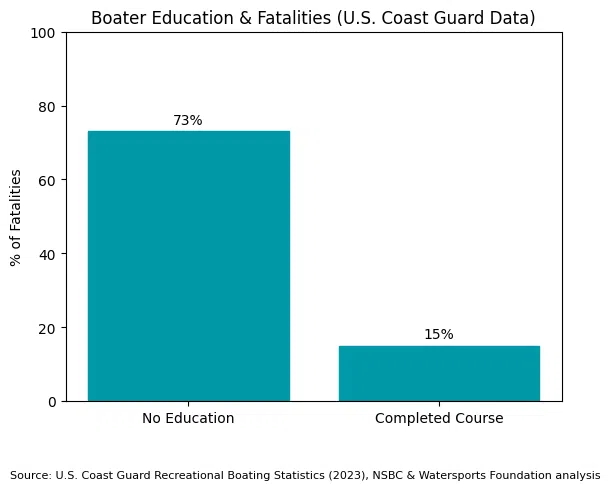
Boater Education reduces accidents and fatalities
Boater education is one of the smartest decisions you can make before heading out on Ohio’s lakes, rivers, and waterways. Studies show that boaters who complete an approved safety course are significantly less likely to be involved in accidents and are better prepared to handle emergencies.
Total Boating fatalities shown as a percent segmented by whether the operator had taken a boater education course.
When you understand how to read the water, anticipate hazards, and react calmly under pressure, you keep yourself, your crew, and fellow boaters safer. That means fewer collisions, fewer drownings, and way more confidence when you’re throttling up on a sunny afternoon. In short, educated boaters help make Ohio waterways safe AND FUN!
Common Misconceptions About the Ohio Boating License
“Ohio issues a boating license like a driver’s license.” Ohio does not issue a traditional boating license. What most people call an “Ohio boating license” is actually a Boater Education Certificate earned after completing an Ohio Department of Natural Resources (ODNR)–approved course.
“Only boat owners need boater education.” Boater education requirements apply to operators, not just owners. If you operate a qualifying vessel, you may be required to carry a boater education certificate even if the boat belongs to someone else or is rented.
“I don’t need a certificate if I’m just riding a jet ski.” Personal watercraft (PWCs), including jet skis, are subject to Ohio’s boater education requirements and additional age restrictions, which are often stricter than those for standard motorboats.
“Out-of-state certificates aren’t valid in Ohio.” Ohio recognizes many out-of-state boater education certificates, provided they are NASBLA-compliant. Always confirm acceptance before operating on Ohio waters.
“Rental companies always provide everything you need.” Some rental operators provide safety briefings or on-the-water instruction, but these do not replace required boater education certification when Ohio law requires it.
“If I was born before the cutoff date, I can ignore boater safety rules.” Even if you’re exempt from mandatory boater education due to age, all operators must still follow Ohio boating laws, safety regulations, and navigation rules at all times.
Ohio Boating License FAQs
Do I need to renew my Ohio Boating License?
No, you do not need to renew the Ohio boating license. It is good for life!
Is the Ohio Boating License good in other states?
Yes! The Ohio Boating License is recognized in all 50 states and Canada. This is known as reciprocity.
How do I replace a lost or stolen Ohio boating license?
If you lose your boating license or it is stolen, contact the course provider who issued your license. As a fallback, you can contact the ODNR or vist ilostmycard.com to obtain a new one. There may be replacement and processing fees.
How old do you have to be to get a Ohio boating license?
In Ohio, there is no minimum age requirement to take a boating safety course, but you do have to be 12 years old to drive a boat, and 16 to operate a PWC.
How much is a boating license in Ohio?
The cost to obtain a boating license online in Ohio ranges from $40 to $60.
What happens if I'm caught boating without my license in Ohio?
Operating a boat in Ohio without meeting boater education requirements can result in enforcement action by the Ohio Department of Natural Resources (ODNR). These requirements exist to promote safety and ensure operators understand Ohio boating laws and navigation rules.
If you are required to have boater education and do not, you may be directed to complete an ODNR-approved boater education course and could be subject to additional penalties, depending on the circumstances of the violation.
About this Article
Written by Jake Waldrop Jake Waldrop is a co-founder and senior leader at Recademics, a nationally recognized provider of outdoor recreation safety education. He leads the development of Recademics’ boating education curriculum and works with boating safety professionals, national standards bodies, and state agencies to ensure content is accredited, state-approved where required, and aligned with current guidance from NASBLA, the U.S. Coast Guard, and applicable state laws.
Reviewed for Accuracy (2026) Reviewed in 2026 by the Recademics Boating Education Team for regulatory accuracy and alignment with current boating safety standards.