
Take an Official State-Approved Boater Safety Course
Quick answer: In Connecticut, most adult visitors can rent and operate a motorboat for short stays (up to 60 days a year) without a Connecticut certificate, but residents, property owners, and anyone using Connecticut waters more than 60 days per year must hold a Safe Boating Certificate (SBC) to operate a motorboat or a sailboat 19.5 feet or longer.
All personal watercraft (PWC/jet ski) operators—resident or not—must have a Certificate of Personal Watercraft Operation (CPWO). Rental companies may set stricter rules and can require proof of education from any renter. Rules are set and enforced by the Connecticut Department of Energy & Environmental Protection (DEEP) Boating Division.
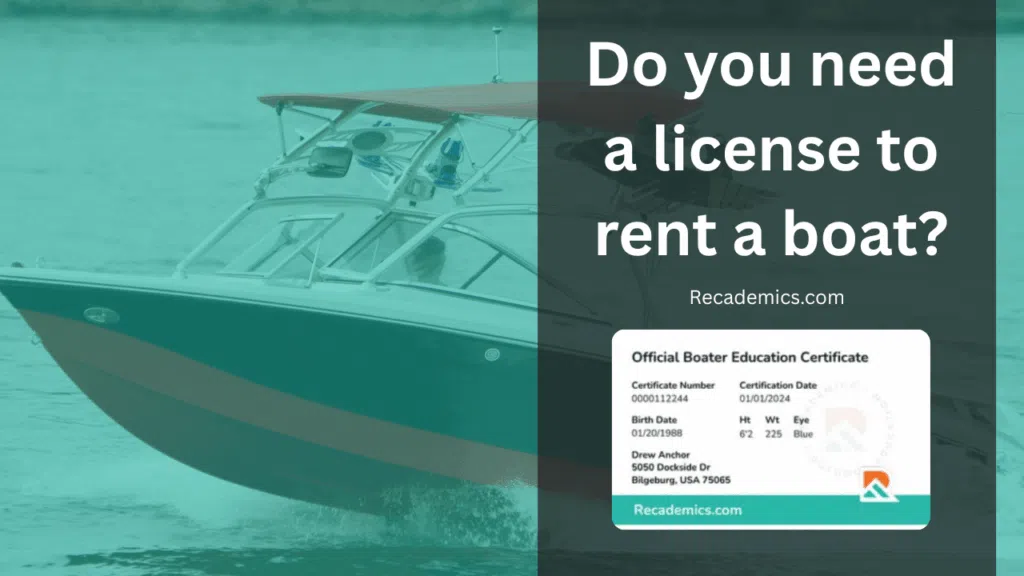
Expect to present a government-issued photo ID, sign a rental agreement, leave a damage deposit, and follow capacity and no-wake rules. Marinas commonly ask who will be operating the boat and may require proof of an SBC/CPWO even when state law doesn’t—especially on busy lakes or coastal harbors. Some outfitters restrict rentals to adults 18+ and may require prior experience for high-horsepower vessels.
Most rental desks provide a dockside orientation covering starting/stopping, local hazards, no-wake zones, life jacket rules, and what to do in an emergency. Many also offer quick skills checks or require riders to watch a safety video. If you plan to tow tubes or skiers, be prepared for additional rules and briefings.
Visitors may operate a motorboat without a CT certificate for up to 60 days/year unless a marina requires it. For PWC, visitors must have acceptable proof of PWC education—Connecticut recognizes CPWO-equivalent credentials from certain neighboring states (e.g., NY, MA, RI, NH). If you move to CT, plan to obtain a Connecticut certificate within 90 days.
If a licensed captain or guide operates the vessel, the captain’s credentials satisfy the legal requirement. Passengers do not need certificates in that case, but rental outfits may still set age or safety rules for participants.
Take a DEEP-approved course that meets state/NASBLA standards. Completing the course qualifies you for an SBC (boats/sail ≥19.5’) or a CPWO (boats + PWC). Courses include Connecticut-specific laws and on-water safety.
Connecticut offers both formats through approved providers and partners (including DEEP, USCG Auxiliary, and Power Squadrons). Always verify that your chosen class is DEEP-approved before enrolling.
Plan for a full-day (around 8 hours) of instruction plus testing time, depending on provider. Some providers split the course over multiple sessions.
Operating a boat or PWC without the required certificate—or failing to carry it on board—can result in citations and fines. Boating Under the Influence (BUI) carries severe penalties, including substantial fines, possible jail time, and suspension of boating privileges. Enforcement is active during peak weekends and special campaigns.
Outfitters are expected to rent only to qualified operators and to provide compliant safety gear. Many marinas verify certificates for PWC or towing activities, may require security deposits, and can refuse rental if state or company rules aren’t met.
DEEP Environmental Conservation (EnCon) Police, along with local marine units and the U.S. Coast Guard on coastal waters, enforce Connecticut’s boating laws, including certificate, equipment, speed/no-wake, and BUI rules.
Connecticut does not issue a driver-style license. Instead, operators carry a boater education certificate issued by DEEP: the SBC (boats/sail ≥19.5’) or the CPWO (boats + PWC). Certificates are generally valid for life once issued.
Yes. Many visitors rent motorboats without a CT certificate for short stays (≤60 days/year), but marinas can require proof of education. Bring government ID and any boater card you hold.
Yes. A CPWO (or accepted equivalent) is required for any PWC operation on Connecticut waters. Certified operators under 16 must have an adult (18+) with a CPWO on board.
For PWC, Connecticut recognizes equivalent credentials from specific reciprocal states (e.g., NY, MA, RI, NH). For boats, many visitors may operate without a CT certificate for up to 60 days, but if you become a resident you must obtain a Connecticut certificate (generally within 90 days). When in doubt, carry your original card and check with the rental marina.

This is a FREE Boating course.